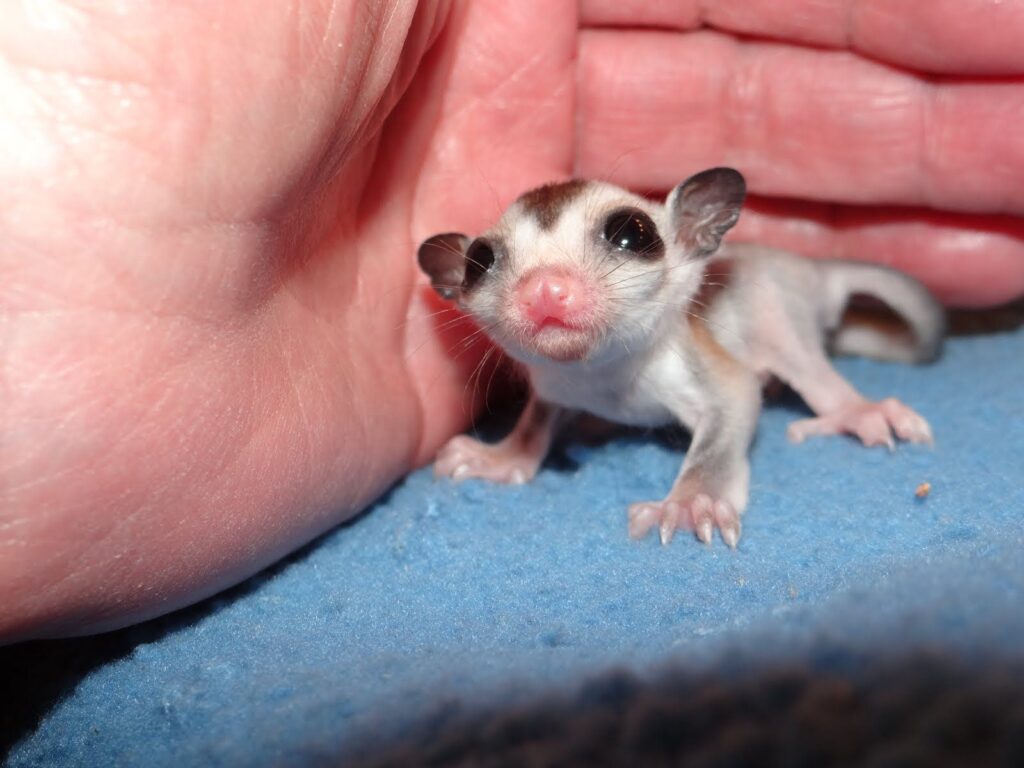
A newborn sugar glider, often called a joey, is one of the tiniest and most delicate marsupial babies in the animal world. When a sugar glider is first born, it is incredibly small—about the size of a grain of rice—and completely undeveloped on the outside. Like all marsupials, the true “birth” is only the beginning of its development. Immediately after being born, the tiny joey instinctively crawls from the birth canal into the mother’s pouch, using nothing but its sense of smell and its small but determined front limbs. Once safely inside the pouch, the joey attaches to a nipple and remains there for about 60 to 70 days, continuing its growth in warmth and protection.
Inside the pouch, the newborn sugar glider gradually develops fur, opens its eyes, and begins to look more like a miniature version of an adult. At this stage, it is still very fragile and completely dependent on the mother. As it grows, the joey becomes more active, stretching, adjusting its position, and occasionally peeking out of the pouch. Caregivers or observers may sometimes catch a glimpse of a tiny nose or tail tip poking out, which is often the first sign that the joey is getting ready to emerge.
When the joey finally reaches the “out-of-pouch” stage, it is still very young. Its fur is soft and thin, its tail is short and slightly wavy, and its movements are clumsy as it adjusts to the world outside the pouch. The baby sugar glider often clings tightly to its mother’s belly or rides on her back, staying close for comfort, warmth, and safety. Even though it is out of the pouch, it continues to nurse and relies on the mother for guidance, learning how to climb, glide, and explore.
The early days out of the pouch are full of curiosity and tiny squeaks as the joey discovers new sounds, scents, and textures. It may cuddle with its parents and siblings, forming the strong social bonds that sugar gliders are known for. As it becomes more confident, it practices small jumps, explores nearby branches or nesting areas, and slowly begins to taste soft foods.
Raising a newborn sugar glider requires gentle handling, patience, and a proper environment. Warmth, nutrition, and minimal stress are essential. Whether observed in the wild or cared for in a safe human setting, a sugar glider newborn represents one of nature’s most delicate and fascinating developmental journeys—a tiny life that transforms from a nearly invisible newborn into an active, gliding, social creature full of energy and charm.